History of the Rottweiler: Origins, Purpose, and the Working-Dog Legacy
DN Rottweilers
AKC Breeder of Merit, OFA Health Testing, 10+ Years Experience
Where the Rottweiler Comes From
The Rottweiler takes its name from Rottweil, a market town in the Baden-Württemberg region of southwestern Germany. For centuries, Rottweil served as a hub for cattle trading, and the local dogs became inseparable from that commerce.
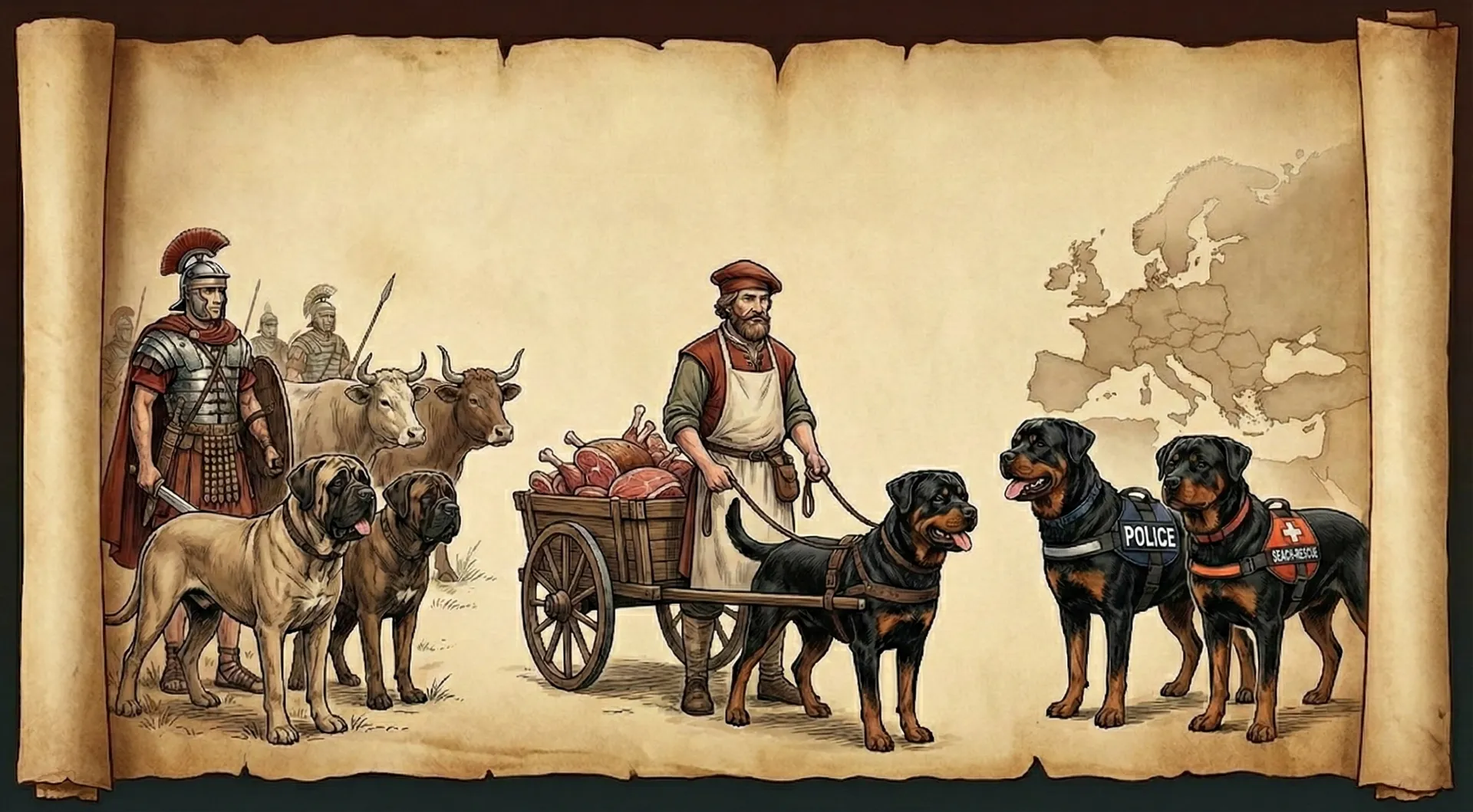
These dogs—known locally as "Rottweiler Metzgerhund" or Rottweil butcher's dogs—earned their keep by driving cattle to market, guarding livestock overnight, and protecting their owners' earnings on the journey home. The name "Metzgerhund" literally translates to butcher's dog, a testament to the breed's close working relationship with cattle merchants and butchers.
"Dawn breaks over the medieval market town. A powerful black-and-tan dog trots beside its master, both heading toward the bustling cattle market where fortunes—and reputations—are made."
The Rottweiler's very name is a geographic stamp of origin—proof of the breed's deep roots in German cattle-trading culture.
The Roman-Route Theory
The most widely cited theory of Rottweiler ancestry connects the breed to drover dogs that accompanied Roman legions as they pushed north through the Alps into Germanic territories. These Roman mastiff-type dogs were used to drive and guard the cattle herds that fed marching armies.
"Roman soldiers march northward through alpine passes, their cattle following behind. Among them move powerful dogs—muscular, alert, tireless—keeping the herd together through treacherous terrain."
As the Romans established settlements in the region that would become Rottweil, their dogs likely interbred with local stock over generations, creating a robust working dog adapted to Central European demands.
Historical Note: While this Roman-route lineage is a cornerstone of Rottweiler breed lore, direct historical documentation from the era is limited. The theory remains widely accepted but should be understood as informed tradition rather than verified fact.
The Butcher's Dog Era
The medieval and early modern periods cemented the Rottweiler's reputation as the quintessential butcher's dog. Their jobs were demanding and varied:
Cattle Droving
Moving herds from farms to the Rottweil market, keeping animals in line over long distances.
Livestock Guarding
Protecting cattle from predators and thieves during overnight camps on droving routes.
Cart Pulling
Hauling butchers' carts laden with meat to market—a testament to their strength.
Money Guarding
Carrying pouches of coins around their necks—born from absolute trust in the dog's protective instincts.
Work Demands → Traits Favored
| Demand | Trait Selected |
|---|---|
| Long-Distance Droving | Endurance, steady temperament |
| Guarding Livestock | Alertness, protective instinct |
| Pulling Heavy Carts | Compact power, strong frame |
| Money Guarding | Loyalty, unwavering trust |
The breed's build—compact, powerful, and balanced—was not designed in a show ring. It was forged through centuries of functional selection.
From Cattle Routes to Modern Roles
The late 19th century brought an existential challenge to the Rottweiler breed. As railroads replaced cattle drives, the traditional droving work that had sustained Rottweilers for centuries rapidly disappeared. By some accounts, the breed's numbers dwindled dramatically—the Rottweiler was at risk of fading into history.
But the same qualities that made Rottweilers exceptional drovers—intelligence, trainability, calm courage, and physical capability—proved valuable in new contexts:
"When the old work disappeared, the Rottweiler's fundamental capabilities translated seamlessly into modern working roles."
Rottweiler Timeline
Roman Drover Dogs
Mastiff-type dogs accompany Roman legions, driving cattle across the Alps into Germanic territories.
Rottweil Emerges
The German market town becomes a hub for cattle trading, giving the breed its name.
The Butcher's Dog
Rottweilers become known as "Metzgerhund" — indispensable partners to butchers and cattle merchants.
Cart-Pulling & Guarding
Beyond droving, Rottweilers pull carts laden with meat and guard their owners' earnings.
Industrial Change
Railroads replace cattle drives, threatening the breed's traditional purpose and numbers.
Breed Clubs Form
Dedicated fanciers preserve and standardize the Rottweiler, establishing the ADRK in Germany.
Police & Service Work
The breed gains recognition worldwide, serving in police forces, military, and protection roles.
Modern Working Dog
Rottweilers serve as guardians, service dogs, competition athletes, and devoted family companions.
The Rottweiler Today
Today's Rottweiler carries forward centuries of working heritage. Whether serving in police K-9 units, working as service dogs, competing in protection sports, or simply standing as a devoted family guardian, the breed remains true to its foundational purpose: a capable, intelligent, and loyal working partner.
The same traits that made the Rottweiler invaluable to medieval butchers—calm confidence, trainability, physical power, and an instinct to protect—continue to define the breed. When you look at a well-bred Rottweiler, you see the culmination of a thousand years of functional selection.
At DN Rottweilers in Dallas, Texas, we honor this heritage by breeding Rottweilers that embody the working character, sound temperament, and physical capability that the breed's history demands.