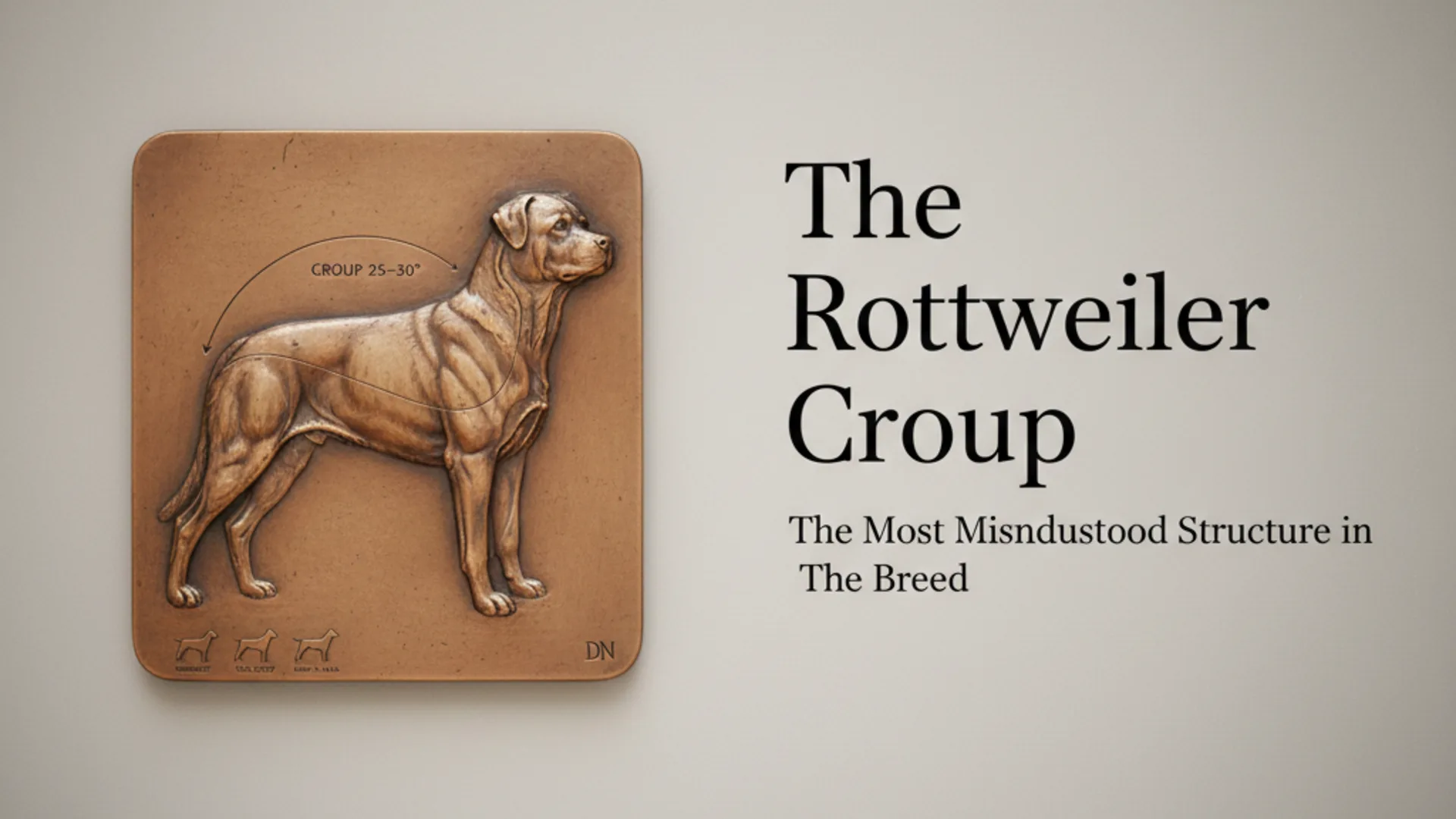
The Rottweiler Croup: The Most Misunderstood Structure in the Breed
DN Rottweilers
AKC Breeder of Merit, OFA Health Testing, 10+ Years Experience
The Rottweiler is a working dog built to trot. Everything about its structure exists to serve one purpose: covering the most ground with the least effort, in an unrestricted, harmoniously flowing, powerful gait.
The croup sits at the exact intersection where rear drive meets the spinal column. It is the structural bridge between the pelvis and the topline. And yet, as veteran Rottweiler judge and breeder Steve Wolfson has noted, the croup's influence on gait and symmetry is "often misunderstood, underemphasized, and passed over by judges" (Total Rottweiler Magazine).
This article explains why the croup matters more than most people realize — and how to evaluate it correctly.
What Is the Croup, Anatomically?
The croup is not a single bone. It is a muscular region formed by three fused sacral vertebrae and the first four to five coccygeal (tail) vertebrae. These structures form a slightly curved area just above and around the set-on of the tail (ShowSight Magazine, "Croup and Tail").
The sacrum — the three fused vertebrae — functions as a single rigid unit. There is no movement possible between them. This is by design: the sacrum forms the anchor point for the entire hind limb assembly. The transverse processes (wings) of the sacrum join to the pelvis via a cartilaginous joint on both sides, creating a very firm connection that allows the direct transfer of drive generated by the hind limbs to the spine.
What the Breed Standards Require
All three major Rottweiler standards describe the same ideal:
- FCI Standard N. 147: "Croup: Broad, of medium length, slightly rounded. Neither flat nor falling away." Faults include "too sloping, too short, too flat or too long" (USRC / FCI Standard).
- AKC Standard: "Croup is broad, of medium length and only slightly sloping" (AKC Rottweiler Standard).
- ADRK Standard (German parent club): Same specifications — broad, medium length, slightly rounded (ADRK).
How the Croup Affects Movement
The Rottweiler's primary gait is the trot — an efficient endurance gait used by wolves, coyotes, and herding breeds to cover vast distances without excessive energy expenditure. At the trot, the rear assembly operates in two phases, as described in detail by the ShowSight article "Dynamics of the Rear Assembly":
Phase 1: Loading (Minimal Drive)
The rear foot lands in front of the hip joint and moves backward. The angles at the hock and stifle close. This phase provides some support and lift to the dog's front, but contributes very little to forward momentum. In fact, the foot action in Phase 1 creates slight resistance as it absorbs impact.
Phase 2: Propulsion (Where Drive Happens)
Once the rear foot passes directly below the hip joint, Phase 2 begins. The rear angles open and extend backward — like the release of a compressed spring. The toes dig into the surface for traction. Energy transfers through a direct path: hock to lower thigh to upper thigh to hip bone to croup to back to front assembly.
The croup is the critical junction in this chain. It is where the kinetic energy from the entire rear assembly enters the spinal column and travels forward. If the croup angle is wrong, this transfer breaks down.
The Four Common Croup Faults
1. Too Steep (Over-Angled Croup)
What it looks like: The croup drops sharply from the loin to the tail set. The tail appears low-set. From the side, the topline "falls away" behind the loin.
What it does to movement: Drive from the rear is directed upward rather than forward. The back rises during movement. The hindquarter's arc of movement is restricted — the dog cannot follow through behind. The rear assembly works harder for less result.
Why it happens: Often accompanies over-angulated rears. As Hedberg notes, at a 40-degree croup angle, "the angle of drive is too high, causing the back to rise during movement" with restricted rear swing.
2. Too Flat (Under-Angled Croup)
What it looks like: The croup is nearly level with the backline. The tail is set high — sometimes appearing to come straight off the back.
What it does to movement: Thrust from the rear is directed below the line of the back. Energy dissipates instead of transferring forward. The dog may appear to trot with effort despite adequate rear angulation. Hedberg notes that at a 10-degree croup, "considerable thrust is lost as it is not transmitted forwards."
Why it happens: Can be genetic or can appear in dogs with excessive topline rigidity. The American Rottweiler Club warns that once correct toplines are lost in a program, "they can take generations — or may never — be regained."
3. Too Short
What it looks like: The distance from the wing of the pelvis to the tail set appears compressed. The thighs may appear narrow from the side.
What it does to movement: A short croup reduces the available surface area for thigh musculature attachment. This limits the width and power of the upper thigh. It also reduces the arc of movement available to the rear assembly, restricting both reach and follow-through. The FCI standard lists "too short" as a specific croup fault.
4. "High in the Rear"
What it looks like: The dog's rear appears higher than its front. The topline slopes downward from back to front rather than remaining level.
What it does to movement: As Wolfson explains, instead of the correct slight downward slope, the croup "can be observed turning upward." This is the opposite of too much downward slope but has a similarly diminishing effect on gait. The dog must work harder to push its body forward, resulting in wasted energy and a choppy, inefficient trot.
Why it happens: Often a combination of flat croup, straight rear angulation, and/or insufficient forechest development. Can also appear temporarily in adolescent dogs going through growth phases.
Why Over-Angulated Rears Make the Problem Worse
There is a dangerous trend in the Rottweiler ring that compounds croup faults: the pursuit of extreme rear angulation.
The ShowSight article on rear assembly dynamics describes this clearly: at a national Rottweiler specialty, a breeder-judge systematically moved dogs with the most rear angulation to the front of the line. "Several were even sickle-hocked. The only thing that mattered was the illusion of power created by the bend at the stifle and hock joints."
The reality of canine biomechanics is more nuanced:
- More angulation is not better. The FCI standard specifies rear bones should meet to form obtuse angles (greater than 90 degrees, less than 180). Anything approaching either extreme is faulty.
- Trotting breeds need the front assembly to be more angulated than the rear — not the other way around. The rear creates energy; the front receives and distributes it. These require different angle sets.
- Moderately angulated dogs produce better sustainable rear drive because their bone lengths allow the foot plenty of ground contact time AND allow the joints to fully extend at the end of the stride, maximizing mechanical advantage.
- Over-angulated dogs cannot fully extend their joints before the stride ends. They use more energy per step and have less stamina — the opposite of what a working trotting breed requires.
What Judges Should Evaluate
The trot is the truth-teller of structure. The American Rottweiler Club states: "The trot is the truth-teller of structure. In the ring, Rottweilers are judged at this gait because it exposes both virtues and weaknesses."
When evaluating croup and rear assembly at the trot, watch for:
- Topline stability: Does the topline remain firm and level, or does it rise in the rear with each stride? Rising indicates a steep croup redirecting drive upward.
- Rear follow-through: Does the rear leg extend fully behind the dog before lifting? Restricted follow-through suggests a short or steep croup limiting the arc of movement.
- Hock opening: Do the hocks fully open at the end of each stride? Hocks that remain bent indicate over-angulation preventing full extension — often worsened by croup faults.
- Overall efficiency: Does the dog cover ground with minimal visible effort? A correct croup allows harmonious energy transfer. An incorrect one forces compensatory movement — crabbing, overreaching, or a choppy stride.
The Balance Equation: Strength, Agility, Endurance
The FCI standard's general description requires the Rottweiler to possess "great strength, agility and endurance." These three qualities form a natural check-and-balance system for evaluating any structural feature:
- A dog with too much substance may have strength but lacks agility and endurance.
- A dog lacking substance may have agility and endurance but lacks strength.
- Only correct structure delivers all three simultaneously.
Protecting Structure Across Generations
The American Rottweiler Club's breeder education program puts it bluntly: "Fault-judge your own dogs more severely than any judge would." Cosmetic traits like slightly light markings can be corrected in a single generation. Structural issues like incorrect croup angle may take years — or may never be fully corrected if ignored.
When evaluating breeding stock, the croup should be assessed with the same rigor as hips, elbows, and dentition. It is not enough for a dog to have a beautiful head and impressive bone. If the croup cannot efficiently transfer the power generated by the rear assembly, the dog is structurally incomplete — regardless of how it looks standing still.
References
- FCI Standard N. 147 — Rottweiler (United States Rottweiler Club)
- AKC Official Standard of the Rottweiler
- ADRK Breed Standard (Allgemeiner Deutscher Rottweiler-Klub)
- Steve Wolfson, "The 7 Deadly Structural Faults" (Total Rottweiler Magazine)
- "Dynamics of the Rear Assembly" (ShowSight Magazine)
- Stephanie Hedgepath, "Croup and Tail" (ShowSight Magazine)
- Karen Hedberg, "An Essay in Canine Conformation"
- Fred Lanting, "Angles Front and Rear" (SiriusDog)
- American Rottweiler Club Breeder Education
- Gillette, R.L. (2019). Athletic and Working Dog: Functional Anatomy and Biomechanics
- Zink, C. & Van Dyke, J.B. (2018). Canine Sports Medicine and Rehabilitation (2nd ed.)
Related Articles
Free Rottweiler Puppies: Adoption, Craigslist & Real Costs
Where to actually find a free or low-cost Rottweiler — and the honest math on Craigslist, "free" puppies, and why the cheapest dog is usually the most expensive one you can buy.
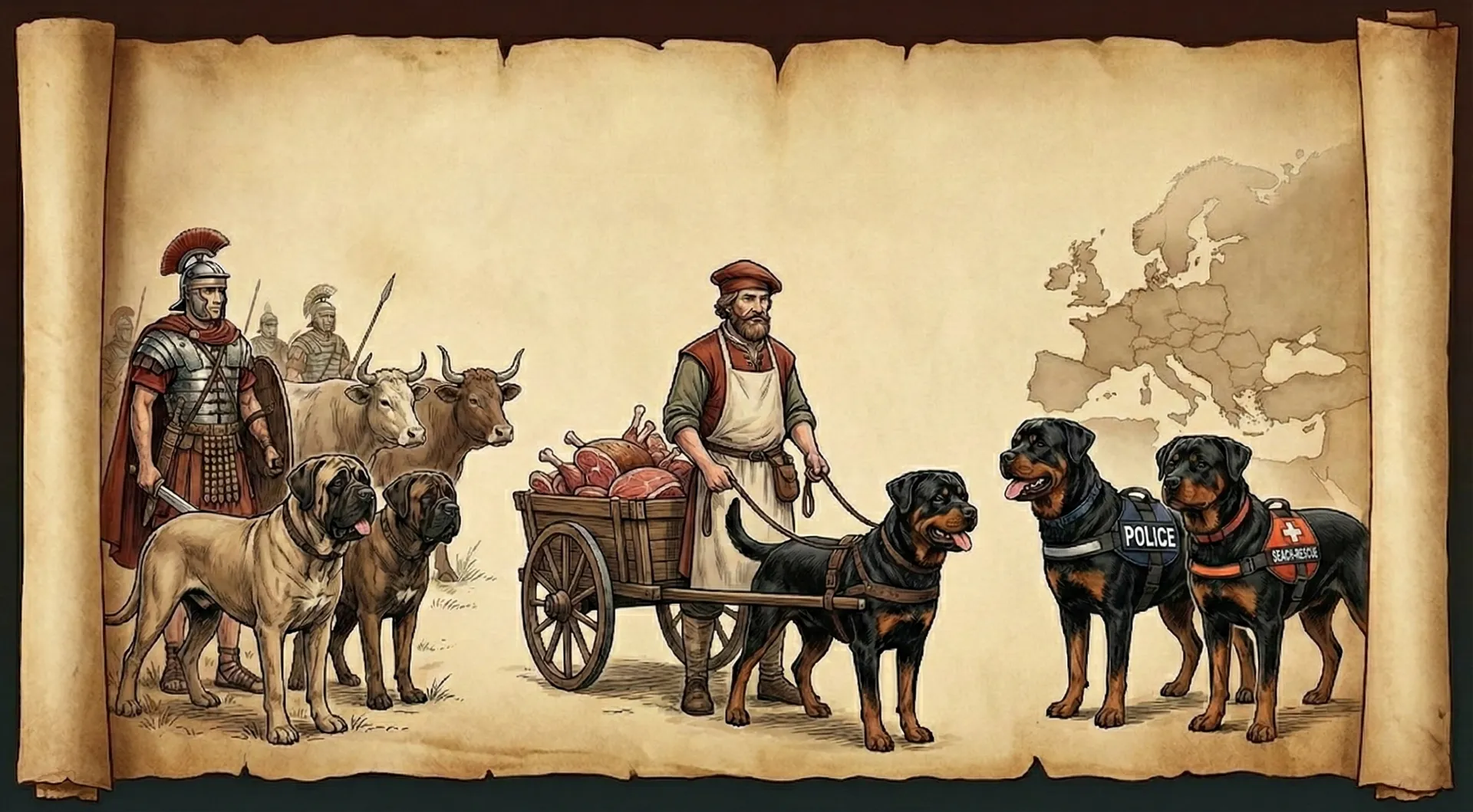
History of the Rottweiler: Origins, Purpose, and the Working-Dog Legacy
Discover the Rottweiler origin story: from Roman drover dogs to Rottweil butchers to modern working roles. Explore the complete breed timeline and heritage.
Looking for a Rottweiler Puppy?
DN Rottweilers produces quality puppies from health-tested, champion bloodlines in Dallas, Texas.